

Kutali Camp or Chula Island Camp – Which Should You Choose in the Lower Zambezi?
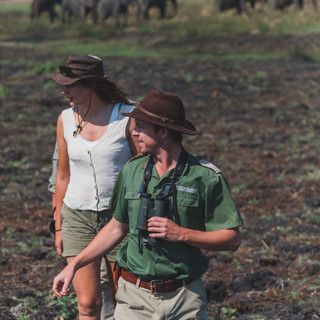

It’s one of the questions we’re asked most often when guests are planning a safari to the Lower Zambezi:
Which is better Kutali or Chula Island Camp?
The short (and slightly frustrating!) answer is: there is no wrong choice. They are very different camps, in very different settings, and both are equally rewarding in their own right. The longer answer – and the one worth unpacking – lies in how these camps came to be, what they were designed for, and how people actually experience them today.
The origins: why these two camps exist at all

Kutali and Chula Island didn’t begin life as stand‑alone safari camps in the way many do today. Their roots lie in the early days of Tusk and Mane Safaris, when the focus was on mobile fly‑camping and on creating a sense of journey through the landscape, rather than hopping between fixed lodges.
The two locations were deliberately chosen as paired sites, ideally suited to a 4–6 night itinerary, linked by a transfer that was very much part of the safari itself. Guests would move between camps on foot, by canoe, by vehicle – or a combination of all three – experiencing the islands, channels, floodplains and forests of the Lower Zambezi along the way.
As the crow flies, the distance between Kutali and Chula Island is only around 12 kilometres. But we are not crows. Moving through this landscape means weaving between channels, skirting islands, crossing plains and forest edges – and that transfer feels far more expansive and immersive than the map suggests. A morning or afternoon spent travelling between the two camps often became one of the highlights of the safari.
That original philosophy still underpins how we think about these camps today.
The classic combination – still as relevant as ever

We still believe that combining Kutali Camp and Chula Island Camp offers one of the most complete introductions to the Lower Zambezi, particularly for guests who have never visited the park before. The two camps sit in complementary but contrasting habitats, and together they showcase just how varied this wilderness really is.
In today’s era of slower, more immersive safaris, we tend to suggest allowing 5 or 6 nights for the combination, rather than trying to squeeze it into a shorter stay. Done at the right pace, the flow between the two camps feels natural and unhurried, and the journey between them remains an experience in its own right.
That said, safari time is precious – and not everyone has the luxury of a longer stay.
Shorter stays: choosing one camp and settling in
If your time in the Lower Zambezi is limited to 3 or 4 nights in total, our advice is usually to choose one camp and fully immerse yourself there.
Both Kutali and Chula Island offer a remarkable variety of activities – not just classic game drives, but also walking safaris, canoeing, boating and fishing. With land‑ and water‑based experiences available from both camps, there is far more to do than at most safari destinations, and no sense of repetition even over several nights.
In short: you won’t feel as though you’re missing out by staying put.

What our repeat guests tell us
Recently, we took a close look at our repeat guests in the Lower Zambezi. We were curious: when people come back, do they return to the same camp, or do they favour one over the other?
The results were fascinating.
The split was almost perfectly even:
One third consider Kutali Camp their favourite and choose to spend all their nights there.
One third feel exactly the same way about Chula Island Camp.
And the final one third choose, once again, to split their time between the two.
If ever there was proof that there is no universally “better” option, this is probably it.
Kutali Camp: forest, shade and big game

Kutali Camp is set deep within the Winterthorn Forest, the largest stand of this dramatic woodland in the Lower Zambezi National Park. It’s a game‑rich, shady, atmospheric environment – very much big game country.
The camp itself is spacious and open, with tents widely spaced and excellent visibility through the surrounding forest. All guest tents face towards the Zambezi River, creating a strong sense of connection to the water while still being firmly rooted in the forest.
Kutali often appeals to guests who love the feel of being enveloped by wilderness: towering trees, dappled light, and the sense that animals could appear from any direction.
Chula Island Camp: water, space and island life

Chula Island Camp is exactly what the name suggests: it sits on a large, private island in the Zambezi River, several kilometres long and around a kilometre wide. With no public access, the island is ours alone – and that sense of exclusivity is palpable.
Game viewing takes place both on the island itself and off‑island for those who want to explore further afield. Access is via a short pontoon crossing across the channel – sturdy, well‑lit, and taking around three minutes door to door.

Chula tends to resonate with guests who are drawn to water‑based landscapes, open spaces, river breezes and the ever‑changing moods of the Zambezi.
The practicalities
Both camps:
Open on 1 April and close in early November
Have 6 guest tents plus 1 guide / tour leader tent
Are accessed via Jeki Airstrip, a scenic 35‑minute flight from Lusaka
From Jeki:
Kutali Camp is approximately 1 hour by road
Chula Island Camp is closer, at around 30 minutes
So… Kutali Camp or Chula Island Camp – Which Should You Choose in the Lower Zambezi?
In truth, it comes down to personal preference – which is exactly why, if time allows, we still love the idea of visiting both. Do that, and you’ll soon discover which “camp loyalist” group you fall into when you return.
But if this is your first time in the Lower Zambezi, don’t overthink it. Whether you choose Kutali Camp, Chula Island Camp, or a combination of the two, you’ll be immersed in one of Africa’s most beautiful and least hurried safari landscapes.
There really is no wrong answer – only different ways of experiencing the same extraordinary wilderness.


Wisata Vietnam travel discussions often mention popular cities and nature spots. Travelers may visit multiple areas. Every place has its own appeal.